Orientation: Grounding through detail
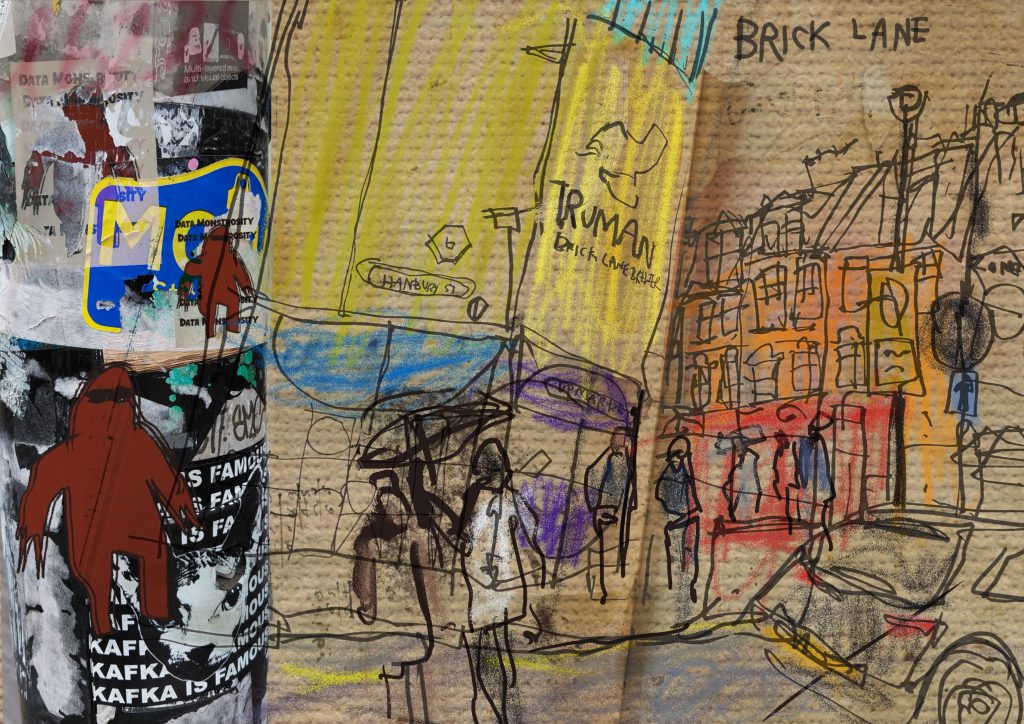
Identify a moment where working at a microscopic scale sharpened or strengthened your understanding of the site. Noting the thickening layers of fly posters gave me the insight of time depth and mediation, which are connected in Brick Lane.
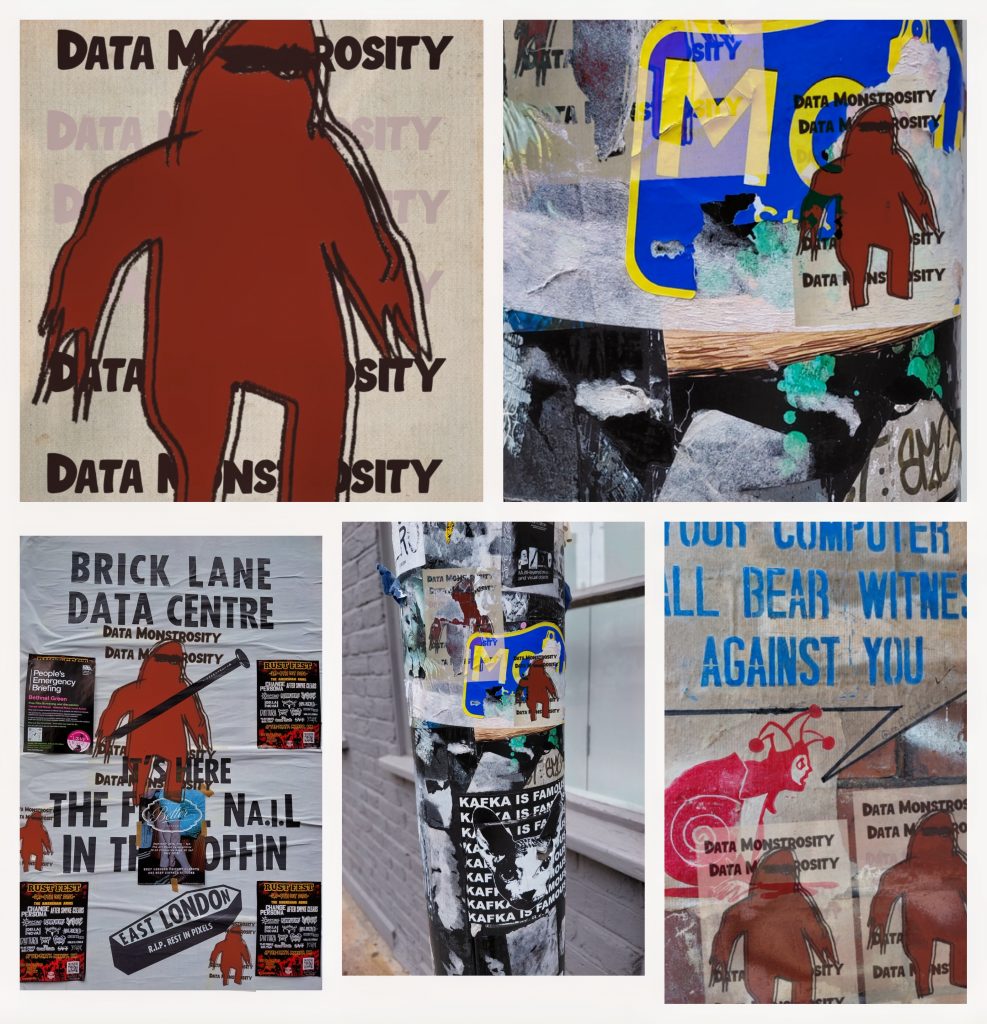
- What did isolating a 1m² section of the site allow you to notice that you might otherwise have missed? Working very closely with one lamppost which contained multiple competing messages in the form of stickers and graffiti.
- How did working within a defined boundary shape the way you looked? I looked at this vertical curved surface as a research space.
- Which method of documentation — drawing, rubbing, sound, film — felt most revealing and why? Drawing a well as the idea of the shrill vibration of a data centre enabled me to see the site via rhythms and frequencies.
Disorientation: When detail becomes abstract
Identify a moment where zooming in unsettled your understanding.
- Did magnification make the site feel unfamiliar or abstract?
- it made me wary of appropriating the golem as an image, as these are textures which do not resonate with my childhood and adulthood in South East London, but I kept seeing reminders of some connections, and read more about the Golem as a protector who becomes a threat, this resonates with emerging technology, which often seems to have a similar trajectory.
- Did surfaces begin to resemble something else? They resemble the body of a monster and a site of completion for space.
What does microscopic disorientation make possible for your developing practice?
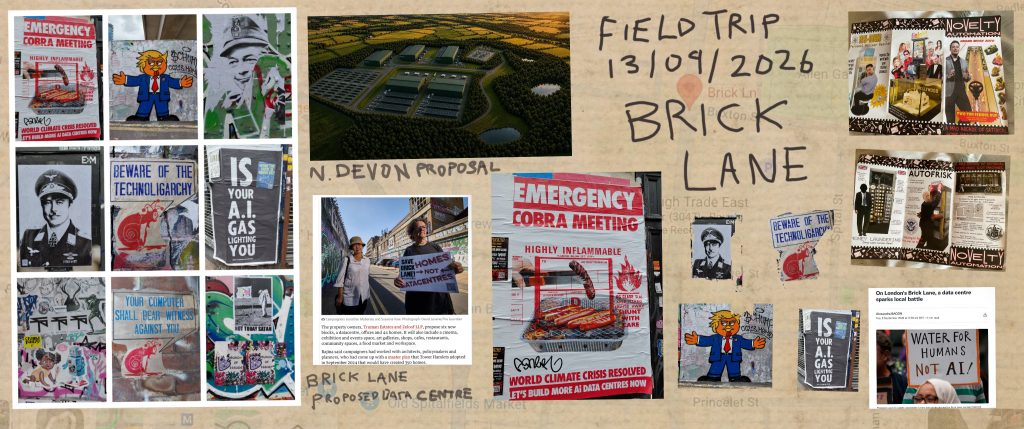
I drew a golem and rapidly prototyped an idea for a sticker protesting the data centre, superimposing it on the images of walls and lampposts which already had many stickers and notices made me reconsider the pressure to find such space, it seems like a form of Babel, a kind of chaos, not unlike the idea of a data centre.
Leave a Reply