This film gave me a weird recurring nightmare or fugue experience as a child in the 1960s. The minute I would close my eyes I’d feel myself floating into space, further and further from the Earth, by opening my eyes I could instantly return to my bed in Forest Hill.
At night I would often dare myself to float further and further away from the planet. Watching the film(s) again immediately evoked that game I had with myself, but also annoyance with the staging of science in an era of escalating Cold War tension, it formed a part of the theatre of Western supremacy, it makes me feel a bit sick now. Eyal Weizman points out how the satellite imagery we can freely access now, in the 2020s has a lower resolution than in previous decades. Now, a human head cannot be detected, this makes it easier to hide violence, and to occlude the presence of communities in landscapes described as ’empty quarters’, such as nomadic people, who seem to be persecuted everywhere.
What interests me is the degree to which these technologies and their mediation become part of our imaginaries, my entire childhood seemed to be engulfed by mediation, such as the PG Tip Tea Cards, most of my (limited) understanding of the world is formed from first retrieving them from a pack of dusty tea bags, sniffing the cards then reading the tiny texts or decoding the images.
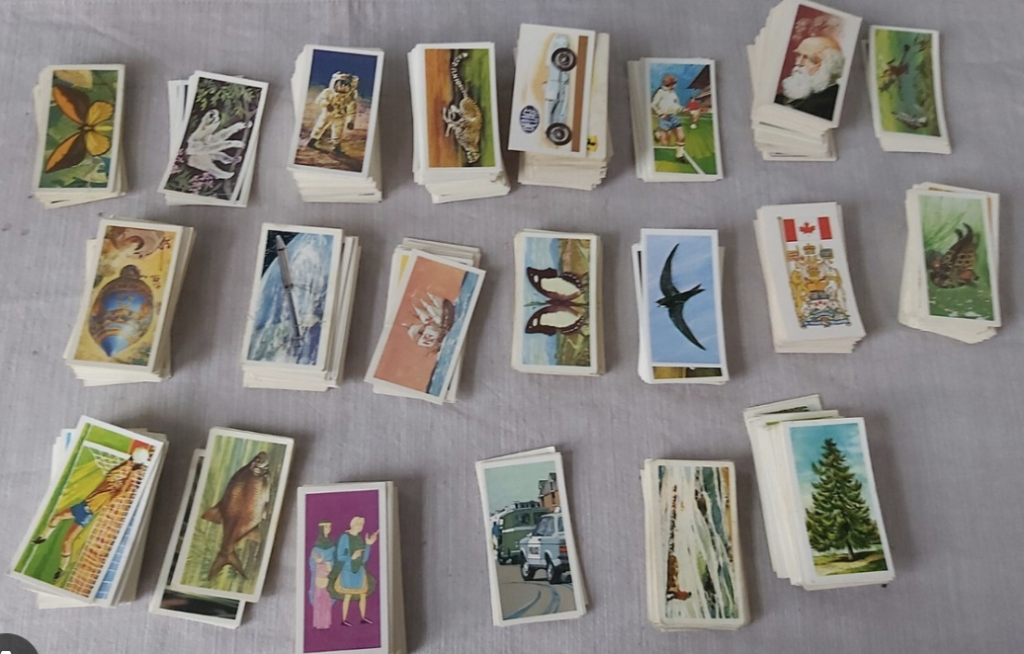
PG Tip tea bag cards, I found this image in eBay. They were often highly colonial, cliched and slanted towards Western narratives of technological superiority, ‘The Race Into Space’, if they existed today I can imagine they would probably feature ‘The AI Race’. The Eames’s film is conflated in my mind with the same ideologies.
Leave a Reply