A dismantled phone reveals handwritten numbers on a small section of aluminium, red notes made by a human in a factory, the script is confident, it carries a subjective presence, I am touched by it, by the worker I will never know.
Below are some photos and woodcuts from the last two summers I spent in North Devon, this year the area is highly stressed by the proposed data centre near Torrington. I documented many protest posters, no one I met believed jobs will be created, instead they are worried about the water stress (there is already a drought), this data ‘campus’ will require a million litres of water a day.
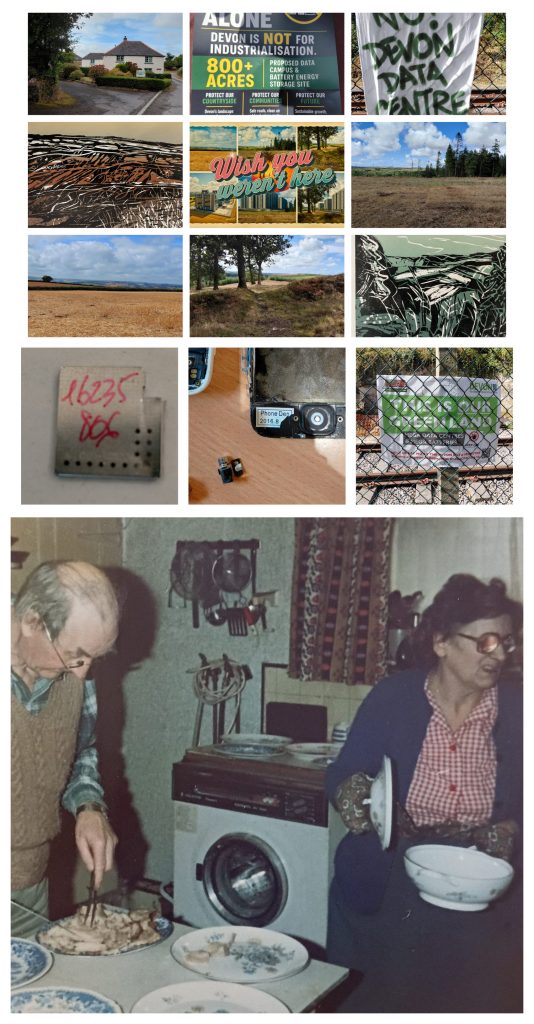
This is a rural community in a UNESCO Biosphere. I did a lot of walking around the proposed area, drawing, woodcuts and a spoof postcard created with Generative AI: the Master’s tools will not dismantle the master’s house, but they sometimes reveal his power structures.
What illustration process will unfold ? I am geographically disoriented as we must choose a site we can return to and I will not return to North Devon until next summer, so perhaps I can work in Brick Lane, as another data centre is proposed there and it is quite close to my home. At this point I don’t know what illustration is but perhaps I will find out what it can be through these research processes.
By a chain of association I keep thinking about my grandmother, Amelia Dagworthy (later Dare), who was from a farm in Devon, where my father was also born. Her washing machine lasted for decades, you can see it in the picture above. She made her own clothes, they grew vegetables and recycled rain water, it’s such a contrast to the proposed data centre, which will take from the ecology with apparently zero benefit to people who do not have shares in a venture capitalised construct of the future.
I attended a lecture by Dr Anne Alexander, she said that data centres often get built beside canals because the cables they depend upon are buried beneath tow paths, ghosts of other empires and hype cycles. I remember my childhood summers spent with my grandparents, playing on the towpath of a canal.
These are my unformed thoughts spinning round:
Tow path
Canal
Kitchen
Railway
Washing machine
Machine learning
Unlearning
A battery made from canal water can power a phone, it lives and tending to it is an act of affiliation or kinship. Borgdorff asks:
“When does art practice count as research? (and its possible corollary: Doesn’t all art practice count as research to some extent?) Can criteria perhaps be formulated that can help to differentiate art practice-in-itself from art practice-as-research? And a concomitant question is: How does artistic research differ from what is called academic or scientific research” (Borgdorff, 2005)
But I think a more urgent question is: what agency might art practice have in the myriad ecological and social crises we face, including the threats to art itself enacted by extractive industries.
Borgdorff, Henk (2005) The debate on research in the arts. lectures and presentations on research in the arts, held in the autumn of 2005 in Ghent, Amsterdam School of the Arts, Amsterdam, Berlin and Gothenburg.
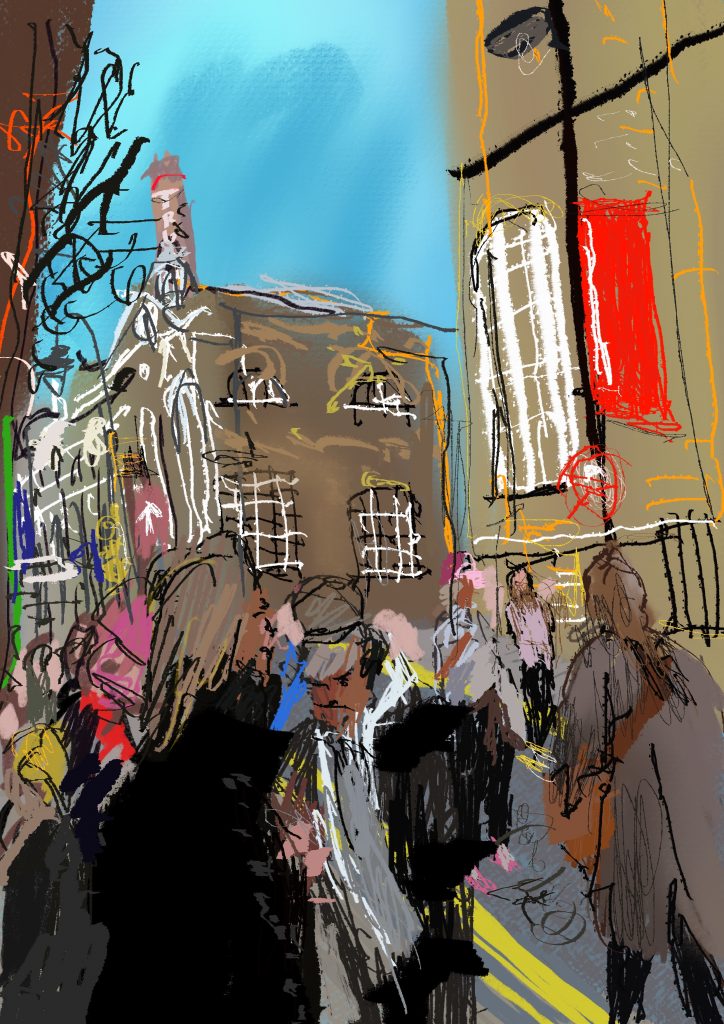
Above, a digital drawing of Brick Lane, near the proposed data centre site, drawn earlier this year
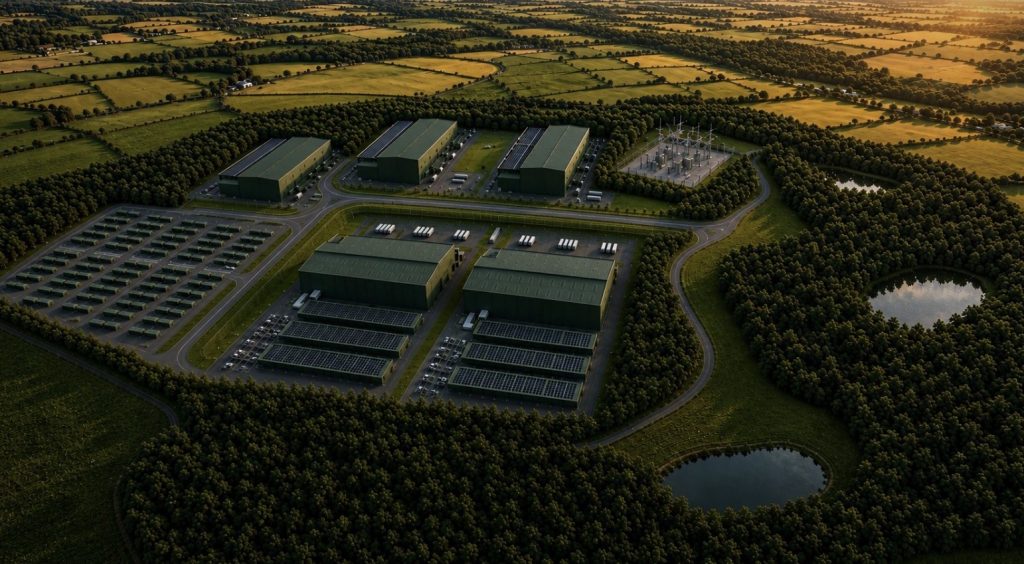
The site is uncertain, hyperbolic, a speculative site, it is represented by unnaturally smooth machine learnt marketing images, visual atrocities, a slop future built on overly optimistic probabilities, there’s no 360 of latent space or an image of a future no one here has asked for and in my mind at least one which is entangled with the past. My father and grandmother were born on a farm in Devon where my relatives still live, it is on the other side of Devon from Torrington, but the idea of a vast data centre in this rural community I know very well is still so disorienting. I can hear my grandmother, Amelia Dagworghy, depicted above, spinning in her grave. I’ve tried to walk around the proposed site but the maps are so unclear I walk in confusion. My drawings are equally uncertain. I have created a number of wooddcuts of the area, they involved gauging and bashing the substrate as an act of fury and contamination.
I can’t go back there before next summer so I’ve switched sites to Brick Lane where another data centre is proposed, also an affront to a community which does not want it and to ghosts who would, I am sure, resist the ideologies of those who proclaim a future defined by regression to the mean, by the dreary and the dominant. Aside from that, I have no idea what the site will bring, I’m still disoriented.
This is the slop image of the proposed ‘campus’, a data centre of 40 storey buildings requiring a million litres of water a day. The proposal has an aura of fiction, a late capitalist hallucination
Leave a Reply